Showing posts with label hearing loss. Show all posts

Wednesday, 31 August 2016

Got the back-to-school blues? This will help!

Feeling the back-to-school blues?  Bummed that summer is over after one final holiday weekend?  This video of a 3-month old boy hearing for the first time is sure to brighten your day and put a smile on your face.  After not responding to hearing tests following his birth, little Jordan underwent more tests and was ultimately diagnosed with a severe-to-profound hearing loss.  Find out a little more about Jordan and his parents' reaction to his first responses to sound. 


Tuesday, 26 July 2016

Communication Considerations for Children With Hearing Loss


Making a life-long decision for a child is never easy, especially after dealing with a possibly unexpected diagnosis of a hearing loss.  Alongside dealing with a roller coaster of emotions, parents need to understand the importance of early intervention on future outcomes.  Many options for communication should be presented to parents, keeping in mind that early exposure to language, in any form, lays the foundation for future communication skills.  Finding a plan that can be supported by parents, siblings, and all other individuals in the child's life is key.  Dive a little deeper into this article to find out more. 


Tuesday, 28 June 2016

Fluctuating Hearing Loss and its Relationship to Listening and Learning Needs

Early reading skills and attention in class are the primary impacts of a fluctuating hearing loss.  Episodes of fluid lasting months at a time can go unidentified and students can appear to be 'hearing when he/she wants to' or 'daydreaming'.  Discover the many factors in a classroom that can affect the listening and learning of a child with fluctuating hearing loss.  


©1991,RelationshipofDegreeofLongtermHearingLosstoPsychosocialImpactandEducationalNeeds,KarenAnderson &NoelMatkin,revised2007 

Saturday, 25 June 2016

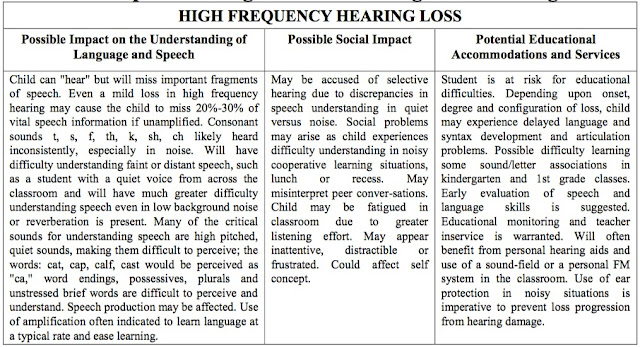
High Frequency Hearing Loss and its Relationship to Listening and Learning Needs

With a high frequency loss, 20-30% of vital speech information can be missed, and many consonant sounds are often heard inconsistently.  This can result in assumptions of selective hearing, and can also cause social problems due to difficulty in noisy environments such as lunch or recess. Early evaluation and educational monitoring are suggested.


©1991,RelationshipofDegreeofLongtermHearingLosstoPsychosocialImpactandEducationalNeeds,KarenAnderson &NoelMatkin,revised2007 


Coming up next: Fluctuating Hearing Loss and its relationship to listening and learning needs

Tuesday, 21 June 2016

Mid-Frequency Hearing Loss and its Relationship to Listening and Learning Needs

Mid-frequency hearing loss means that there is a range of sounds that the individual will have difficulty hearing especially in noisy environments as opposed to an impaired ability at all frequencies of sound.  This can mean missing out on 30% of speech information, which can, in turn, affect the production of these sounds as well.  Find out what this means for a child in the classroom. 


©1991,RelationshipofDegreeofLongtermHearingLosstoPsychosocialImpactandEducationalNeeds,KarenAnderson &NoelMatkin,revised2007 


Coming up next: High-Frequency Hearing Loss and its relationship to listening and learning needs

Saturday, 18 June 2016

Severe and Profound Hearing Loss and their Relationship to Listening and Learning Needs

"Individual ability and early intensive intervention will determine the degree that sounds detected will be discriminated and processed by the brain into meaningful input" (Anderson, 2007).    In mainstream classrooms, children with a severe or profound hearing loss may become more dependent on adults and socialization with hearing peers may be difficult.  


©1991,RelationshipofDegreeofLongtermHearingLosstoPsychosocialImpactandEducationalNeeds,KarenAnderson &NoelMatkin,revised2007 


Coming up next: Mid-Frequency Hearing Loss and its relationship to listening and learning needs

Tuesday, 14 June 2016

Moderate to Severe Hearing Loss and its Relationship to Listening and Learning Needs

When it comes to moderate to severe hearing loss, even with hearing aids, children will miss fragments of what is said, making noisy environments especially difficult to manage.  Depending on the timing and addressing of the loss, many elements of expressive language can be impacted by such a loss.  


©1991,RelationshipofDegreeofLongtermHearingLosstoPsychosocialImpactandEducationalNeeds,KarenAnderson &NoelMatkin,revised2007 


Coming up next: Severe and Profound Hearing Loss and their relationship to listening and learning needs

Saturday, 11 June 2016

Moderate Hearing Loss and its Relationship to Listening and Learning Needs

Moderate Hearing Loss can mean missing  more than 80% of speech signals.  80%!  The significant lack of input that is received becomes reflected in the expressive language of these individuals, leading to social barriers and necessary accommodations. 


©1991,RelationshipofDegreeofLongtermHearingLosstoPsychosocialImpactandEducationalNeeds,KarenAnderson &NoelMatkin,revised2007 


Coming up next: Moderate to Severe Hearing Loss and its relationship to listening and learning needs

Wednesday, 8 June 2016

MORE on the Relationship of Hearing Loss to Listening and Learning Needs

Before we dove into the helpful and interesting facts for Speech and Hearing Month in May, we took a quick look at the relationship of a minimal hearing loss to listening and learning needs.  A slightly greater loss, a mild hearing loss introduces new challenges for a learner in a noisy classroom.  Check it out.   


©1991,RelationshipofDegreeofLongtermHearingLosstoPsychosocialImpactandEducationalNeeds,KarenAnderson &NoelMatkin,revised2007 


Coming up next: Moderate Hearing Loss and its relationship to listening and learning needs

Saturday, 7 May 2016

Hearing Loss and it's Relationship to Listening and Learning Needs

When we think of hearing loss, it's easy to focus the attention simply on the auditory input that is being missed.  But even a minimal hearing loss can have a significant impact on learning, understanding language, and social interactions.  See below a straightforward review of minimal hearing loss and it's relationship to listening and learning needs.  

MINIMAL HEARING LOSS (16-25 dB)
Possible Impact on the Understanding of Language and Speech
Possible Social Impact
Potential Educational Accommodations and Services
Impact of a hearing loss that is approximately 20 dB can be compared to ability to hear when index fingers are placed in your ears. Child may have difficulty hearing faint or distant speech. At 16 dB student can miss up to 10% of speech signal when teacher is at a distance greater than 3 feet. A 20 dB or greater hearing loss in the better ear can result in absent, inconsistent or distorted parts of speech, especially word endings (s, ed) and unemphasized sounds. Percent of speech signal missed will be greater whenever there is background noise in the classroom, especially in the elementary grades where instruction is primarily verbal. Young children have the tendency to watch and copy the movements of other students rather than attending to auditorily fragmented teacher directions.
May be unaware of subtle conversational cues which could cause child to be viewed as inappropriate or awkward. May miss portions of fast-paced peer interactions which could begin to have an impact on socialization and self concept. May have immature behavior. May be more fatigued due to extra effort needed for understanding speech.
Due to noise in typical classroom environments which impede child from having clear access to teacher instruction, will benefit from improved acoustic treatment of classroom and sound-field amplification. Favorable seating necessary. May often have difficulty with sound/letter associations and fine auditory discrimination skills necessary for reading. May need attention to vocabulary or speech, especially when there has been a history of ear problems. Depending on loss configuration, may benefit from low power hearing aid with personal FM system. Appropriate medical management necessary for conductive losses. Inservice on impact of minimal" hearing loss on language development, listening in noise and learning, required for teacher.

©1991,RelationshipofDegreeofLongtermHearingLosstoPsychosocialImpactandEducationalNeeds,KarenAnderson &NoelMatkin,revised2007