Saturday, 9 July 2016

Breakthrough study pinpoints genetic conditions behind intellectual disabilities

Researchers out of British Columbia have identified the genetic underpinning of certain intellectual disabilities in children (CTV News, 2016).  Being able to identify the underlying genetic conditions means target treatment can be offered in as many cases as possible.  In specific cases, the right intervention has decreased self-injurious behaviour, improved overall mood, and has even increased communication skills. 


Tuesday, 5 July 2016

Missed preschool opportunity

Preschool is a wonderful time for diverse learning opportunities.  But is the focus on academics overpowering some important life skills?   Executive function skills, including paying attention, setting goals, planning, and organizing, are a critical foundation for academic skills and can influence a child's classroom behaviour in the future.  Could the narrowed focus on learning things like letters and numbers mean missing this key opportunity to teach other important life skills?  


USA Today: We're missing a big preschool opportunity

Saturday, 2 July 2016

Experts unveil new sleep guidelines for children

First-ever official recommendations for sleep requirements for children are here. 
With lack of sleep a growing trend, it's important to remember that sleep - though taken lightly by many - is just as important as what you eat or how much exercise you're getting. 
Having consistent sleep routines and eliminating screens from bedrooms can help to increase sleep time which improves attention, memory, and overall mental and phyiscal health.


Tuesday, 28 June 2016

Fluctuating Hearing Loss and its Relationship to Listening and Learning Needs

Early reading skills and attention in class are the primary impacts of a fluctuating hearing loss.  Episodes of fluid lasting months at a time can go unidentified and students can appear to be 'hearing when he/she wants to' or 'daydreaming'.  Discover the many factors in a classroom that can affect the listening and learning of a child with fluctuating hearing loss.  


©1991,RelationshipofDegreeofLongtermHearingLosstoPsychosocialImpactandEducationalNeeds,KarenAnderson &NoelMatkin,revised2007 

Saturday, 25 June 2016

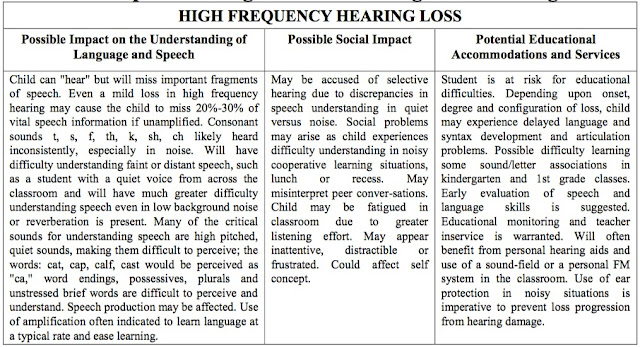
High Frequency Hearing Loss and its Relationship to Listening and Learning Needs

With a high frequency loss, 20-30% of vital speech information can be missed, and many consonant sounds are often heard inconsistently.  This can result in assumptions of selective hearing, and can also cause social problems due to difficulty in noisy environments such as lunch or recess. Early evaluation and educational monitoring are suggested.


©1991,RelationshipofDegreeofLongtermHearingLosstoPsychosocialImpactandEducationalNeeds,KarenAnderson &NoelMatkin,revised2007 


Coming up next: Fluctuating Hearing Loss and its relationship to listening and learning needs

Tuesday, 21 June 2016

Mid-Frequency Hearing Loss and its Relationship to Listening and Learning Needs

Mid-frequency hearing loss means that there is a range of sounds that the individual will have difficulty hearing especially in noisy environments as opposed to an impaired ability at all frequencies of sound.  This can mean missing out on 30% of speech information, which can, in turn, affect the production of these sounds as well.  Find out what this means for a child in the classroom. 


©1991,RelationshipofDegreeofLongtermHearingLosstoPsychosocialImpactandEducationalNeeds,KarenAnderson &NoelMatkin,revised2007 


Coming up next: High-Frequency Hearing Loss and its relationship to listening and learning needs

Saturday, 18 June 2016

Severe and Profound Hearing Loss and their Relationship to Listening and Learning Needs

"Individual ability and early intensive intervention will determine the degree that sounds detected will be discriminated and processed by the brain into meaningful input" (Anderson, 2007).    In mainstream classrooms, children with a severe or profound hearing loss may become more dependent on adults and socialization with hearing peers may be difficult.  


©1991,RelationshipofDegreeofLongtermHearingLosstoPsychosocialImpactandEducationalNeeds,KarenAnderson &NoelMatkin,revised2007 


Coming up next: Mid-Frequency Hearing Loss and its relationship to listening and learning needs

Tuesday, 14 June 2016

Moderate to Severe Hearing Loss and its Relationship to Listening and Learning Needs

When it comes to moderate to severe hearing loss, even with hearing aids, children will miss fragments of what is said, making noisy environments especially difficult to manage.  Depending on the timing and addressing of the loss, many elements of expressive language can be impacted by such a loss.  


©1991,RelationshipofDegreeofLongtermHearingLosstoPsychosocialImpactandEducationalNeeds,KarenAnderson &NoelMatkin,revised2007 


Coming up next: Severe and Profound Hearing Loss and their relationship to listening and learning needs

Saturday, 11 June 2016

Moderate Hearing Loss and its Relationship to Listening and Learning Needs

Moderate Hearing Loss can mean missing  more than 80% of speech signals.  80%!  The significant lack of input that is received becomes reflected in the expressive language of these individuals, leading to social barriers and necessary accommodations. 


©1991,RelationshipofDegreeofLongtermHearingLosstoPsychosocialImpactandEducationalNeeds,KarenAnderson &NoelMatkin,revised2007 


Coming up next: Moderate to Severe Hearing Loss and its relationship to listening and learning needs

Wednesday, 8 June 2016

MORE on the Relationship of Hearing Loss to Listening and Learning Needs

Before we dove into the helpful and interesting facts for Speech and Hearing Month in May, we took a quick look at the relationship of a minimal hearing loss to listening and learning needs.  A slightly greater loss, a mild hearing loss introduces new challenges for a learner in a noisy classroom.  Check it out.   


©1991,RelationshipofDegreeofLongtermHearingLosstoPsychosocialImpactandEducationalNeeds,KarenAnderson &NoelMatkin,revised2007 


Coming up next: Moderate Hearing Loss and its relationship to listening and learning needs